Enhancing Digital Art with Music Instrument Procreate Brush Stamps: A Practical Guide for Creators
Digital illustration has evolved far beyond simple sketching tools, offering artists a vast ecosystem of resources to streamline workflow and enhance visual storytelling. Among these resources, Music Instrument Procreate Brush Stamps have emerged as a valuable asset for designers, hobbyists, and professional illustrators alike. These digital stamps allow users to instantly integrate detailed musical imagery into their compositions without the need to draw each element from scratch. By leveraging hand-drawn aesthetics, these brushes bridge the gap between technical precision and organic artistic expression, providing a unique texture that vector graphics often lack.
For iPad users working within the Procreate environment, understanding how to effectively utilize these stamps can significantly expand creative possibilities. This guide explores the distinct characteristics of music instrument brush stamps, compares them to alternative methods, and evaluates when they are the most appropriate choice for your digital craft.
Understanding the Distinct Appeal of Hand-Drawn Stamps
The primary value of Music Instrument Hand drawn Brush Stamps lies in their aesthetic authenticity. Unlike sterile, computer-generated icons, hand-drawn stamps retain the imperfections and line variations characteristic of traditional pen-and-ink illustrations. This quality is crucial for projects aiming for a warm, approachable, or vintage feel. When you apply a stamp of a saxophone or a piano, the resulting image carries the weight of human craftsmanship, making it ideal for editorial illustrations, greeting cards, and social media content where personality is paramount.
These stamps are not merely static images; they are dynamic tools within the Procreate interface. Users can adjust size, opacity, and rotation with intuitive gestures. Furthermore, the ability to recolor these elements using your custom color palette allows for seamless integration into any design scheme. Whether you need a muted pastel flute for a nursery decoration or a bold, high-contrast drum set for a concert poster, the flexibility of these brushes ensures they adapt to your vision rather than dictating it.
Comparing Brush Stamps to Alternative Illustration Methods
When deciding whether to use Music Instrument Procreate Brush Stamps, it is helpful to compare them against other common approaches to incorporating musical imagery into digital art. Each method has distinct tradeoffs regarding time investment, customization, and final output quality.
- Manual Drawing: Drawing instruments like a harp or a clarinet from scratch offers maximum control over perspective and detail. However, complex instruments with intricate mechanisms, such as a baritone or a trombone, require significant technical skill and time. Brush stamps eliminate this barrier, allowing artists to focus on composition and color rather than structural accuracy.
- Vector Graphics: Vector files offer infinite scalability and clean lines, making them suitable for large-format printing. Yet, they often appear rigid and lack the organic texture that hand-drawn stamps provide. For digital-first content or textured prints, the raster-based nature of Procreate stamps offers a more tactile and engaging visual experience.
- Stock Photography: While photos provide realism, they can clash with illustrated styles and often require extensive editing to match lighting and color tones. Hand-drawn stamps maintain stylistic consistency with other illustrated elements in your artwork, ensuring a cohesive look.
The decision ultimately depends on the project’s goals. If hyper-realism is required, photography or detailed manual rendering may be necessary. However, for stylized, decorative, or conceptual pieces, Music Instrument Hand drawn Brush Stamps offer an efficient balance of quality and convenience.
Exploring the Collection: Ten Essential Instruments
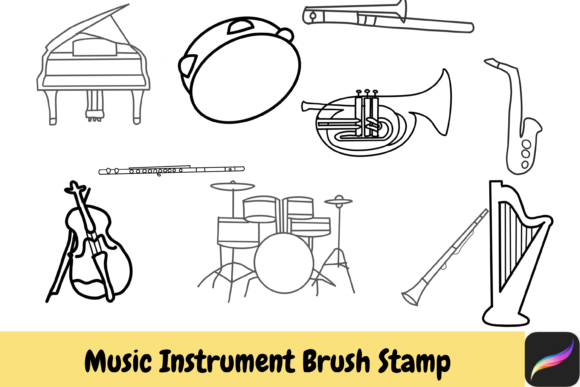
A versatile brush set typically includes a diverse range of instruments to cover various musical genres and visual themes. Let us examine how ten specific hand-drawn instruments can be utilized creatively within your Procreate projects.
- Saxophone: With its curvaceous body and intricate keywork, the saxophone is a staple for jazz-themed designs. Its silhouette is instantly recognizable, making it perfect for background patterns or focal points in nightlife illustrations.
- Piano: Whether depicted as a grand piano or an upright, this instrument symbolizes elegance and classical music. Use piano stamps to add a sense of sophistication to wedding invitations or educational materials.
- Def (Daf): This frame drum adds a cultural and rhythmic element to designs. Its circular shape works well in mandala-style compositions or bohemian-themed artwork, offering a distinct alternative to standard Western percussion.
- Drum: A standard drum kit or snare provides energy and movement. These stamps are ideal for rock or pop-themed graphics, where dynamic angles and bold colors can convey volume and beat.
- Keman (Violin): The violin’s slender form and f-holes create delicate visual lines. It is excellent for romantic or classical motifs, adding a touch of grace to floral arrangements or poetic layouts.
- Baritone: As a larger brass instrument, the baritone adds visual weight and complexity. Its coiled tubing offers interesting geometric patterns that can break up empty space in dense compositions.
- Trombone: The slide mechanism of the trombone introduces linear elements that can guide the viewer’s eye across the canvas. It is particularly effective in illustrating motion or musical progression.
- Harp: With its vertical strings and curved frame, the harp brings a sense of height and ethereal beauty. It works beautifully in dreamy, fantasy-inspired scenes or celestial themes.
- Flute: The flute’s slender, horizontal profile makes it a subtle yet effective decorative element. It pairs well with nature-themed illustrations, evoking sounds of the wind and outdoors.
- Clarinet: Similar to the flute but with a darker, richer tone visually, the clarinet fits well in academic or orchestral contexts. Its jointed structure adds rhythmic repetition to linear designs.
Practical Application and Creative Freedom
The true power of Music Instrument Procreate Brush Stamps emerges when users move beyond simple placement and begin experimenting with layering and modification. Because these stamps are designed for decoration and imagination, there are no strict rules for their application. You might overlay a semi-transparent harp over a watercolor background to create depth, or scatter small flute icons to form a border around a text block.
Color customization is a critical feature. Procreate’s robust color picker allows you to sample hues directly from your existing artwork, ensuring that a bright red drum or a gold saxophone harmonizes with the rest of the piece. This adaptability means that a single brush set can serve multiple projects with vastly different moods simply by changing the palette. For instance, monochromatic blue stamps might suit a calm, nocturnal scene, while vibrant, multicolored instruments could energize a festival poster.
Evaluating Limitations and Best-Fit Scenarios
While highly versatile, these brushes are not a universal solution. They are best suited for stylized, illustrative work rather than technical diagrams or photorealistic renderings. If your project requires precise anatomical accuracy of an instrument’s mechanics for educational purposes, manual drawing or 3D modeling may be more appropriate. Additionally, because these are raster-based stamps, excessive enlargement beyond their original resolution may result in pixelation, though Procreate’s high-resolution canvas capabilities mitigate this risk for most standard uses.
Readers should consider these stamps as tools for enhancement rather than replacement for fundamental skills. They are ideal for:
- Quick prototyping of design concepts.
- Adding decorative flair to journals, planners, and digital scrapbooks.
- Creating cohesive thematic elements for social media branding.
- Illustrators who wish to focus on narrative and composition over repetitive detailing.
Making an Informed Decision
Choosing to incorporate Music Instrument Hand drawn Brush Stamps into your workflow is a decision based on efficiency and aesthetic preference. If you value the organic, hand-crafted look and need to produce content regularly, these tools offer a significant advantage. They allow you to maintain a consistent style while reducing the time spent on repetitive drawing tasks.
However, if your work demands absolute uniqueness in every line or requires scalable vector formats for large-scale commercial printing, you may need to complement these stamps with other techniques. The most effective digital artists often blend multiple approaches, using stamps for base elements and manual drawing for fine-tuning and personalization.
Ultimately, the goal is to let your imagination lead. Whether you are arranging a whimsical scene with a dancing clarinet and a floating harp or designing a sophisticated header with a grand piano, these brushes provide the building blocks. By understanding their strengths and limitations, you can integrate them seamlessly into your creative process, enhancing your digital craft with the timeless appeal of music and art.